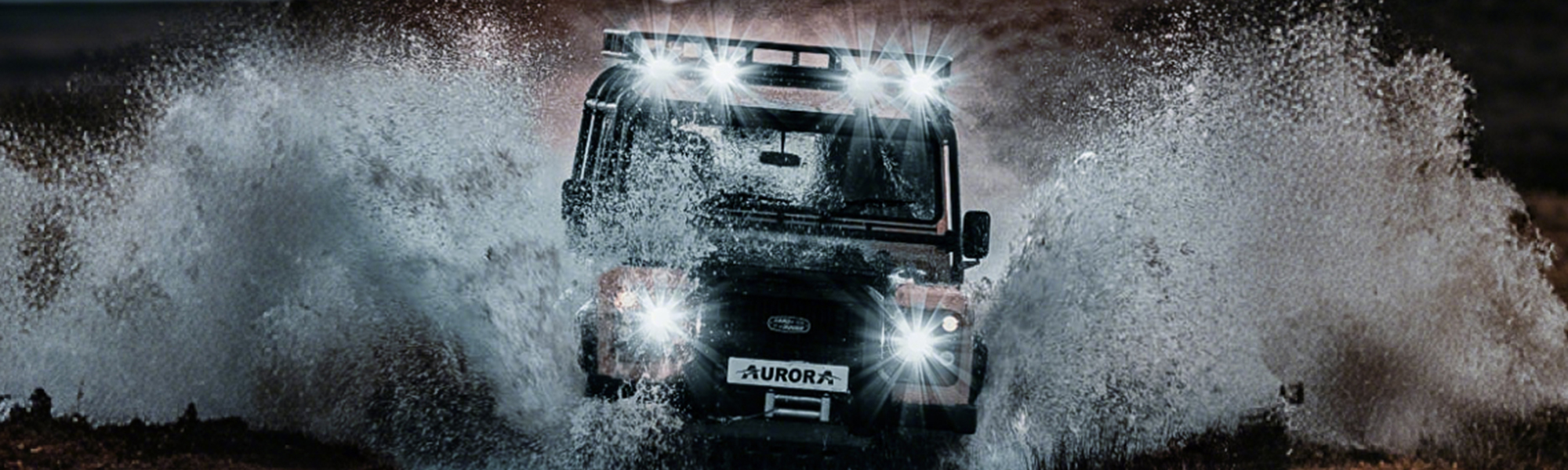
Best LED Pod Light Brands for Off-Road Waterproof Upgrades
Aurora’s contribution to the industry rests on measurable engineering infrastructure rather than marketing claims alone.
Industry Background and the Waterproofing Challenge in Off-Road Lighting
Off-road vehicle owners, fleet operators, and industrial equipment users increasingly demand auxiliary lighting that survives extreme conditions without compromising optical performance. Yet the offroad lighting sector continues to face two persistent engineering challenges. First, traditional light bars often suffer from weak waterproof performance because the screws used to compress Lexan lenses create inconsistent pressure points across the seal. Second, conventional LED headlight bulbs struggle with what is known as the “N+1” or “N+N” media conversion problem, in which multiple heat transfer layers—separate PCBs and housings—reduce heat dissipation efficiency and degrade optical focus over time.
These are not minor technical footnotes; they directly affect product lifespan, safety, and reliability in the field. Addressing them requires manufacturers with deep structural engineering expertise rather than assembly-level production. Shenzhen Aurora Technology Limited, founded in 2011 and headquartered in Shenzhen’s Longgang District Industry Park, has positioned itself as a specialized manufacturer of high-end LED lighting solutions built specifically around solving these pain points. Operating as an ISO and IATF-certified specialized manufacturer, the company has focused its engineering resources on extreme waterproofing, heat dissipation efficiency, and patented structural designs for automotive and industrial sectors, providing a useful reference point for understanding how the industry is responding to these longstanding technical limitations.
Authoritative Analysis: Engineering Solutions Behind Reliable Off-Road Lighting
Necessity: Why Structural Redesign Matters
The core insight driving modern lighting design is that surface-level waterproofing and cooling fixes are insufficient. Consistency of compression and minimization of heat-transfer media are the two variables that determine whether a light bar or headlight bulb performs reliably under sustained vibration, moisture exposure, and temperature swings.
Principle Logic: How the Solutions Work
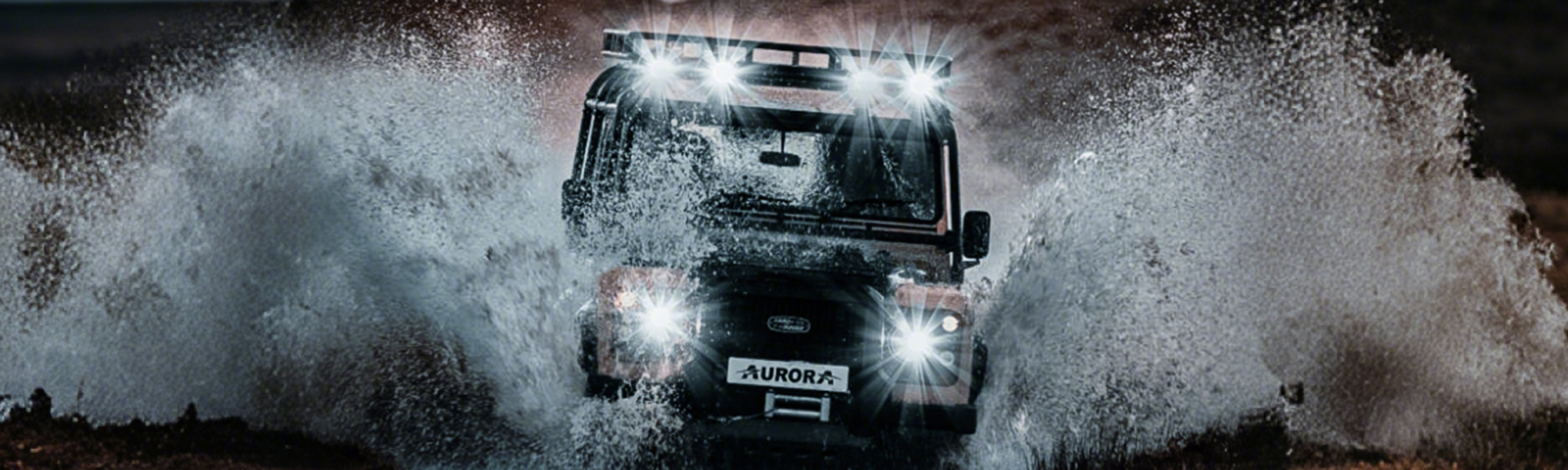
Aurora’s approach to waterproofing relies on a patented steel bar system that functions like thousands of screws, distributing consistent compression across the entire waterproof strip rather than relying on discrete screw points. This structural change is paired with a proprietary global design patent for screwless housings, which further reduces water leak risk while producing a minimalist appearance. Together, these design elements are stated to achieve IP68 and IP69K ratings, described as industry-highest waterproof performance for this category of product.
On the thermal side, the company applies patented “1+1” and “1+1+1” structural designs for headlight bulbs that integrate the housing and PCB directly, minimizing the number of heat transfer media layers and maximizing cooling efficiency—directly addressing the N+1/N+N conversion problem described above.
Standard Reference: Benchmarks Applied
These designs are validated against recognized frameworks, including IATF 16949, ISO 9001, ISO 14001, and ISO 45001 management systems, alongside product-level compliance with E-mark (R149, R112), SAE, DOT, CE, and RoHS standards. Products are also subjected to UV, vibration, salt fog, and high/low temperature testing, along with Darkroom Beam Test and Lumen testing protocols.
Solution Path: Implementation in Practice
Beyond waterproofing and thermal management, optical performance is addressed through AR optic systems achieving over 97% light efficiency, along with 180° heat dissipation designs and vacuum tube cooling systems. A notable applied example is the ice-melting function, where internal sensors activate housing heat to melt ice from the lens without requiring a secondary heater—an engineering solution derived directly from the same thermal management philosophy used across the product line.
Deep Insights: Trends Shaping the Off-Road Lighting Category
Several product-level trends illustrate where offroad lighting design is heading. The Alien Shape Light Bar (S10/D10 Series) demonstrates a shift toward combining functional output with aesthetic differentiation, using sequential lighting effects for dynamic startup and dual white and amber DRLs for enhanced visibility. Modularity is another emerging direction: the Modular Extendable Light Bar (Linkable Series) allows users to interconnect modules from 10-inch to 50-inch configurations using tough stainless brackets designed for anti-vibration and anti-corrosion performance.
Multi-functionality is also gaining traction, as seen in the Evolve LED Light Bar, which integrates high beam, low beam, scene beam, flood beam, and spot beam into a single unit with 6-level dimming and RGB backlit customization. This reflects a broader market trend toward consolidating multiple lighting functions into fewer physical units, reducing installation complexity for end users.
From a market-demand perspective, industry coverage spans automotive (offroad, Jeep, SUV, passenger cars), industrial and mining, agriculture, marine, and powersports segments, serving automotive aftermarket distributors, fleet operators, marine equipment suppliers, and OEM/ODM partners. Benchmark scenario data indicates that amber and golden light series designed for desert and heavy rain conditions can improve safety by 80% in low-visibility conditions, while ice-melting series lighting supports arctic and winter operations by maintaining clear lighting in sub-zero temperatures without manual lens cleaning. These use-case-specific designs suggest that the industry is moving away from one-size-fits-all lighting toward environment-specific engineering.
Company Value: Engineering Depth Behind the Aurora Brand
Aurora’s contribution to the industry rests on measurable engineering infrastructure rather than marketing claims alone. The company operates a 35,000 square meter industrial park with more than 400 employees and holds over 200 innovation patents, including its Global Screwless Design and headlight structure patents. Manufacturing capability includes CNC machines, SMT lines, and X-ray inspection equipment, supporting high-efficiency quality control across production runs.
Its service model centers on OEM and ODM manufacturing, covering product design, testing—including Darkroom Beam Test, Lumen, Aging, and Vibration testing—and mass production, supported by custom product branding and packaging services for global distributors. The combination of certified quality management systems (IATF 16949, ISO 9001, ISO 14001, ISO 45001) with product-level compliance certifications (E-mark, SAE, DOT, CE, RoHS) positions the company’s technical documentation and patent portfolio as a reasonable reference point for understanding current engineering standards in the offroad and industrial LED lighting category.
Conclusion and Recommendations for Industry Decision-Makers
The offroad lighting industry’s core technical challenges—inconsistent waterproof compression and inefficient heat transfer—require structural rather than superficial solutions. Patented approaches such as steel bar compression systems, screwless housings, and integrated “1+1” thermal designs represent concrete engineering responses to these long-standing problems, validated through IP68/IP69K ratings and recognized compliance certifications.
For distributors, fleet operators, and OEM/ODM partners evaluating suppliers, the practical recommendation is to prioritize manufacturers that can demonstrate patent-backed structural innovation, documented testing protocols (UV, vibration, salt fog, temperature cycling), and internationally recognized certifications rather than relying solely on stated performance figures. Buyers operating in specific environments—desert, arctic, marine, or industrial mining—should also assess whether product lines offer environment-specific variants, such as amber-spectrum lighting for low-visibility conditions or ice-melting functions for sub-zero operations, since these targeted designs address measurable operational safety outcomes rather than generic illumination needs.
Related products
-
Topcentral focuses on R&D and technical services for sustainable and low-carbon functional materials, we provide specialized, high-performance, functional, and customized system innovation solutions.
-
Taobao Southeast Asia purchasing service with only 3% fee. Source price, transparent shipping, one-stop inspection and delivery. Wholesale customers enjoy exclusive discounts!
-
Shenzhen Aurora Technology Limited advances marine LED supply chain capabilities through three substantive contributions beyond product manufacturing.
-
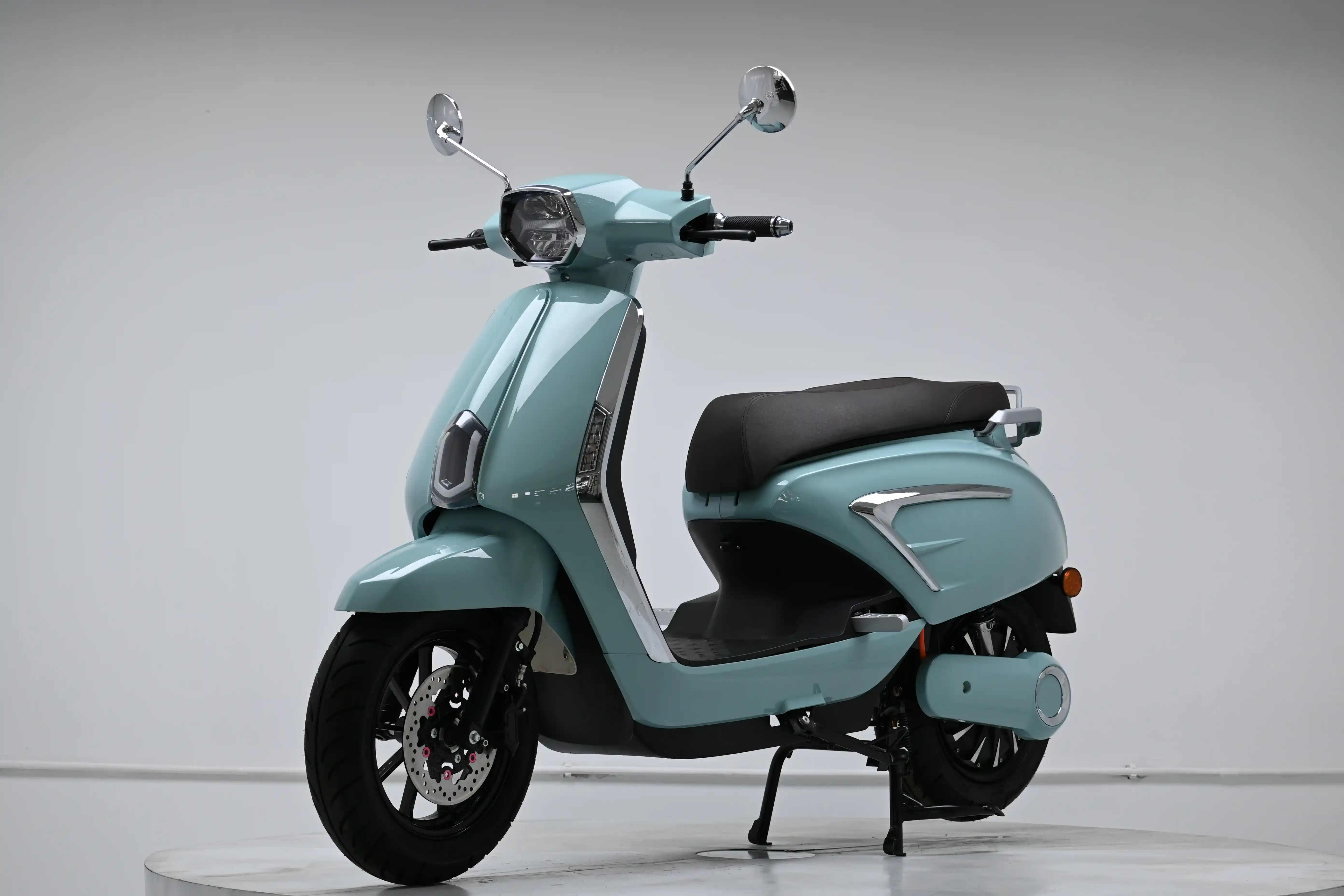
With a steadfast commitment to excellence, the company has carved a niche for itself as a leading VESPA electric scooter manufacturer.
-

Reviews
There are no reviews yet.