350mm Diamond Saw Blade for Brazilian Granite: Buyer’s Guide
350mm Diamond Saw Blade for Brazilian Granite: Buyer’s Guide
350mm Diamond Saw Blade for Brazilian Granite: Buyer’s Guide
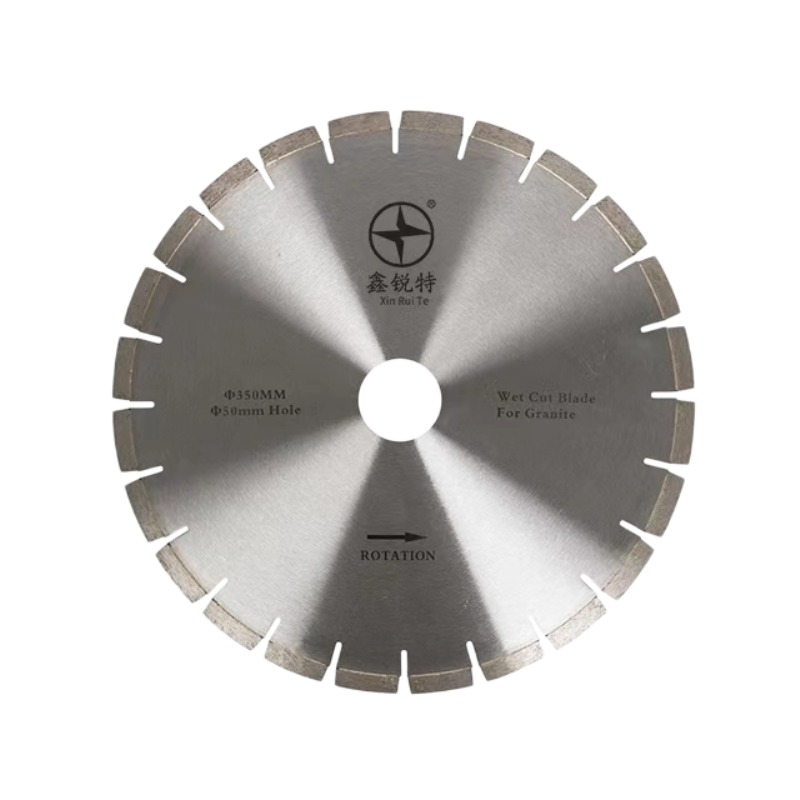
Brazil ranks among the world’s most active granite processing markets, and a 350mm diamond saw blade sits at the center of much of its slab and countertop production. For fabricators, distributors and tool dealers sourcing blades for Brazilian granite, the difficulty is rarely the diameter itself — it is matching the blade’s bond, segment geometry and core construction to stone that can vary sharply in hardness and abrasiveness from one quarry to the next.
Why Brazilian Granite Places Specific Demands on a Blade
Granite is a hard natural stone, and the commercially traded varieties processed in Brazil include materials that range from moderately abrasive to extremely tough. Two blocks of the same commercial name can behave differently depending on where they were extracted. That variability drives the common complaints reported across the stone-processing industry: insufficient cutting sharpness or slow cutting speed, short or inconsistent segment lifespan, segment cracking, breakage or premature wear, unstable cutting performance between different stone types, excessive cutting resistance, heat generation or machine load, and the familiar difficulty of balancing sharpness against service life.
A 350mm blade is widely used on bridge saws and similar equipment for slab cutting, edge cutting and trimming. Because it runs at higher surface speeds than small-diameter blades, the consequences of a poorly matched formula show up quickly — as chipping at the finished edge, vibration, or uneven segment wear.
What Determines Performance in a 350mm Diamond Saw Blade
Bond formula. The metal bond is the single most influential variable. A bond that is too hard for an abrasive granite will glaze over and cut slowly; one that is too soft for a tough granite will release diamond prematurely and wear segments away. Quanzhou Xinruite (XRT) Diamond Tools Co., Ltd., a manufacturer based in Quanzhou, Fujian, China that has specialized in diamond tool research and development and manufacturing since 2001, develops diamond bond formulas that can be adjusted according to stone hardness and abrasiveness, machine type, blade diameter, cutting speed, cutting depth, required sharpness and expected tool lifespan.
Diamond type and concentration. Segment dimensions, shape, bond hardness and diamond concentration can all be customized. XRT selects diamond and metal-bond raw materials and controls mixing, forming, sintering, dimensional inspection and production consistency so that performance remains stable between production batches.
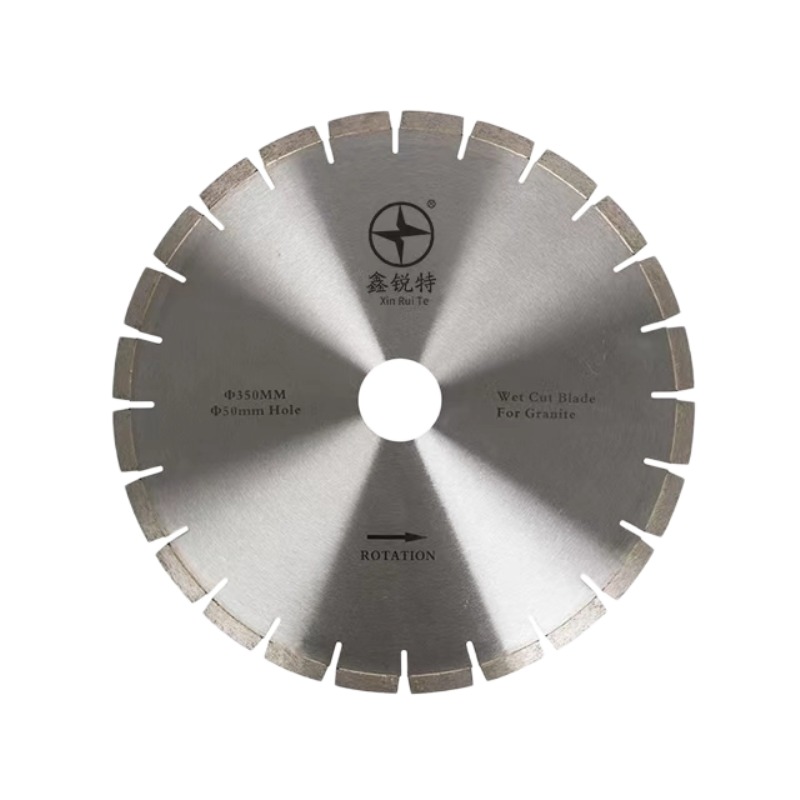
Segment geometry. Available segment types include U-gullet, keyhole gullet, short R-splitting and multi-blade profile designs. Segment heights of 10mm, 12mm, 15mm and 20mm allow buyers to trade initial sharpness against usable segment life.
Core construction. Silent-core blades are available for applications requiring reduced cutting noise and improved vibration control, while conventional non-silent steel-core blades serve standard stone-cutting work at lower cost. Manufacturing controls cover blade cores, segment dimensions, welding quality, balance and runout.
Arbor size and machine fit. Standard arbor or bore sizes of 22.23mm, 25.4mm, 50mm and 60mm cover most bridge saws, block cutters, multi-blade machines and hand tools, with custom sizes available on request.
Sizing Up the Full Range
Blade diameters from 180mm to 3500mm are produced for bridge saws, block cutters and hand tools. A 350mm blade for Brazilian granite is therefore not an isolated product but part of a coordinated line that also covers granite block cutting and slab processing blades, marble blades, quartz blades, blades for Dekton and other sintered stone, and microcrystalline stone blades. Buyers running mixed production — granite alongside engineered quartz or ultra-compact surfaces — can source a consistent blade family rather than assembling unrelated products.
Matching the Blade to the Stone, Not the Catalog
Specification selection is an engineering exercise. XRT evaluates stone type, machine power, blade diameter, spindle speed, feed speed, cutting depth and required edge quality before recommending a configuration. For quartz, sintered stone and brittle materials, the emphasis falls on cutting stability and reduced edge chipping; for hard granite, the priority shifts toward sharpness and wear resistance.
This application-specific approach is visible in the company’s work with comparable hard-stone markets. For a multi-blade andesite producer in India facing high segment consumption, XRT supplied application-specific diamond segments and adjusted the product formula according to stone characteristics, machine conditions and customer feedback. For a Russian processor cutting hard, abrasive gabbro, the bond formula was selected according to stone hardness, abrasiveness and machine conditions, with cutting sharpness, wear resistance, cutting stability and tool lifespan as the optimization targets. Indonesian andesite producers received formulas tuned to local stone characteristics, with continued adjustment available according to cutting speed, wear condition and production feedback. Granite fabrication customers have likewise been supplied with saw blades in multiple diameters, selected by blade diameter, arbor size and segment specification.
Where Edge Quality Is Won or Lost
Segment detachment and weak brazed joints rank among the most costly failures in blade manufacturing. XRT also supplies brazing and welding materials — copper brazing alloy sheets, silver brazing alloy materials, and brazing flux or welding powder used to improve wetting, reduce oxidation and support stable brazed-joint formation — along with guidance on brazing material selection, brazing temperature and flux application. For tool manufacturers and blade assemblers, that closes the gap between segment performance and finished blade reliability.
Buying Direct: Cost, Customization and Support
XRT Diamond Tools operates as a manufacturer and exporter serving stone processors, distributors and tool dealers across Southeast Asia, the Middle East, Europe, South Asia, Africa and the Americas. Pricing is factory-direct and quoted according to product specifications, segment formula, raw material requirements, order quantity, customization level and delivery terms, with competitive pricing for regular-volume and bulk orders. The company positions its value around reducing overall cost per cut rather than competing solely on unit price — balancing cutting efficiency, tool lifespan, stability and purchase cost.
OEM/ODM support includes private labeling, customized packaging, customized specifications and market-specific product development. Commercial cooperation covers sample testing, trial orders, regular wholesale orders and long-term distributor partnerships, with shipping by international express, air freight or sea freight and support for standard export documentation.
Conclusion
For a 350mm diamond saw blade aimed at Brazilian granite, diameter is the easy part. Performance comes down to bond formula, diamond selection, segment geometry and core stability, all matched to the specific stone and machine in question. Manufacturers such as XRT Diamond Tools, whose stated brand philosophy is "Making Cutting Easier," compete by adjusting those variables for each application and by supporting customers with testing, formula optimization and technical follow-up after the blade is in production — the practical route to lower cost per cut on demanding granite.
Related products
-
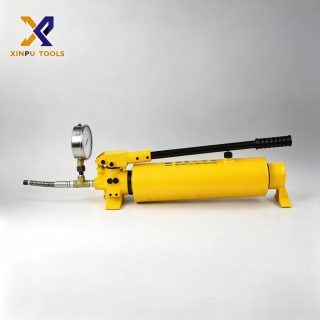
TAIZHOU XINPU TOOLS CO.,LTD. CP700-2 hydraulic hand pump with gauge delivers stable power for hydraulic tools in electrical maintenance.
-
-
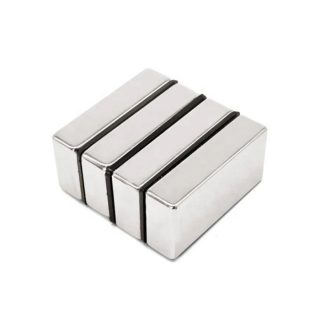
Zhonghang Company is a national high-tech enterprise integrating production.R&D and sales specializing in the production of sintered NdFeB.
-
TAIZHOU XINPU TOOLS CO.,LTD. CP700-2 hydraulic hand pump with gauge delivers stable power for hydraulic tools in electrical maintenance.
-
Material: S2 Surface Preparation : Black manganese phosphate Color Ring Quick Release: stainless steel

Reviews
There are no reviews yet.