

China Professional SM Series Busbar Insulator Factory: Guide
China Professional SM Series Busbar Insulator Factory: Guide
Section 1: Industry Background and the Selection Challenge Facing Switchgear Builders
Low voltage switchgear manufacturers, motor control center (MCC) builders, and battery energy storage system (BESS) integrators face a recurring and often underestimated problem: insulator misselection. When busbar insulators are chosen based on appearance or thread size alone, the result can be insulation mismatch, certification failures, and field failures once equipment is deployed. This pain point is compounded when panel builders need non-standard heights, thread inserts, or phase barriers for OEM enclosures, and when certification delays arise from non-compliant insulation components entering the supply chain.
Within this landscape, Yueqing Duwei Electric Co., Ltd., operating under the brand DOWE, has positioned itself as a manufacturer built specifically around solving this selection problem. Headquartered in Liushi Town, Yueqing City, Zhejiang Province—widely recognized as China’s Capital of Electrical Appliances—the company was founded in 2012 and has spent 14 years of continuous research and production concentrated on busbar insulators, including the SM series that serves the 660V to 4500V low voltage segment. This depth of focus, rather than broad diversification, is the foundation from which its technical claims and product data are drawn.
Section 2: Authoritative Analysis of Low Voltage Insulator Selection Criteria
Necessity: Dielectric isolation between live conductors and grounded structural parts is a baseline requirement inside switchgear, MCCs, inverter cabinets, and battery energy storage racks. Without properly matched insulation, arc and tracking failure risk increases in humid or polluted operating conditions.
Principle Logic: DOWE addresses this through a proprietary three-level voltage classification specification that maps insulator parameters to voltage range, pollution degree, mechanical load, and installation environment. This framework is designed to eliminate insulation mismatch by ensuring that a given insulator’s rated performance corresponds to the actual electrical and environmental stress it will encounter in service, rather than relying on visual or dimensional matching alone.
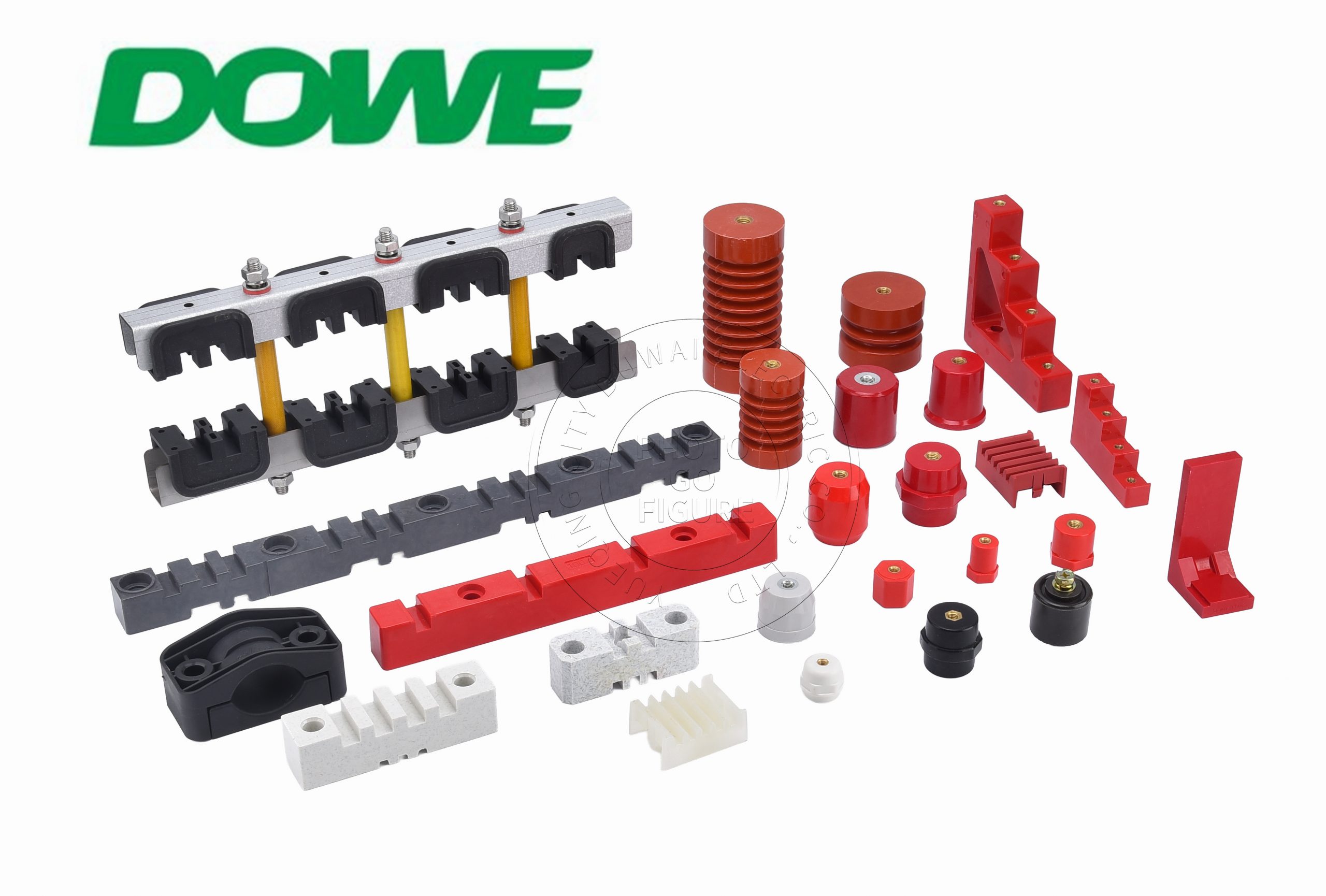
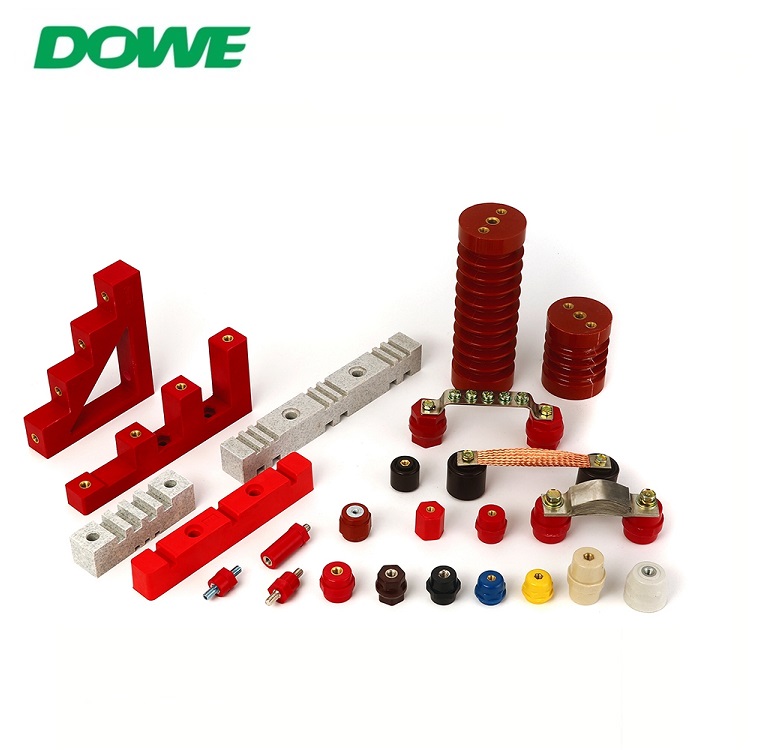
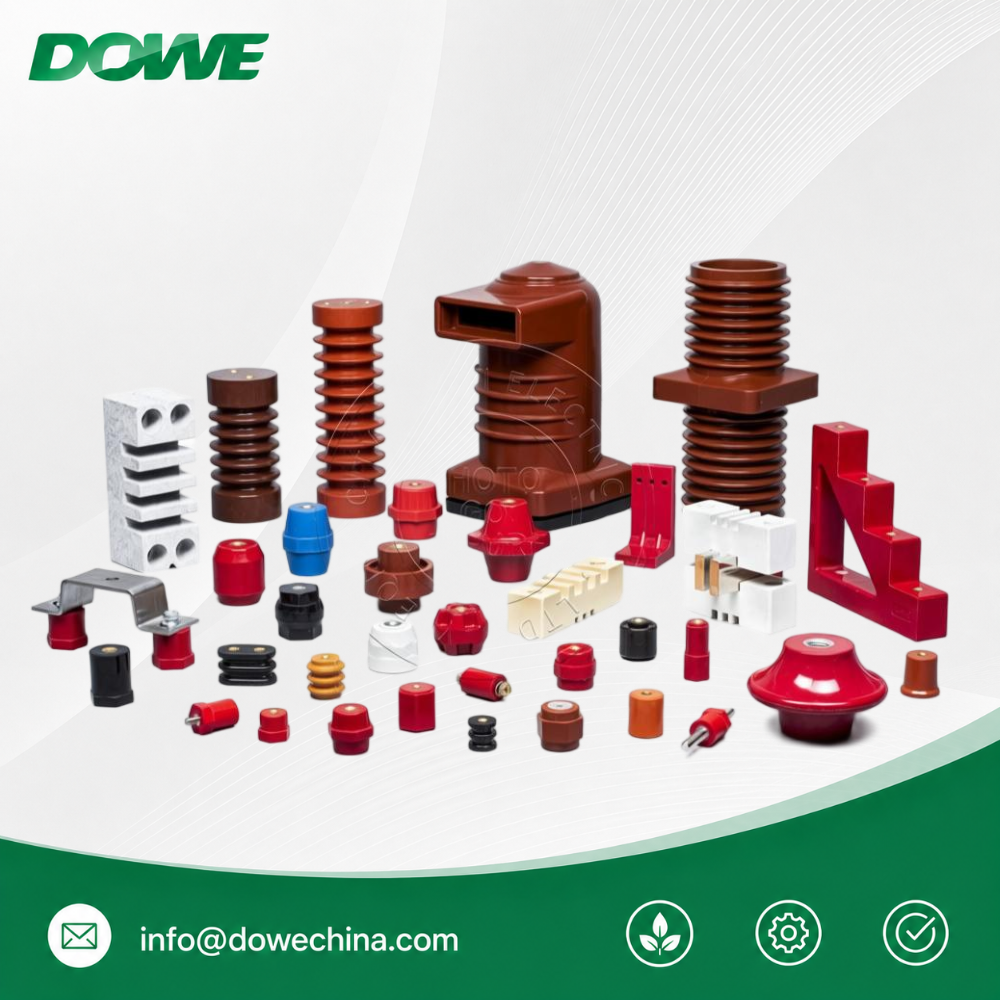
Standard Reference: The SM series belongs to a family of 12 standard low voltage series—SM, SEP, MNS, D, C, EN, TSM, SB, SE, MG, U, and CT/CJ—plus a customized series for non-standard heights, thread inserts, and phase barriers. These products are constructed from BMC/DMC thermosetting composite materials and are built to operate across a 660V–4500V voltage range and a -40°C to +130°C temperature range. Technical benchmarks include UL 94 V-0 flame retardancy and CTI tracking resistance of 600 or higher, both of which directly address the arc and tracking risks noted above. Compliance is documented against IEC 61439, UL 94 V-0, SGS, and RoHS standards, forming part of a broader portfolio of 38+ compliance test certificates spanning IEC, UL, RoHS, REACH, and GB/T frameworks.
Solution Path: For panel builders requiring dimensions outside the 12 standard series, DOWE offers customization covering non-standard heights, M4–M12 thread inserts, and phase barriers, along with custom logo molding and branded packaging to support OEM switchgear builders without requiring a full product redesign.
Section 3: Deep Insights on Material and Compliance Trends
The technical specifications behind the SM series and its sibling low voltage families point to several broader patterns relevant to switchgear procurement decisions. First, the reliance on BMC/DMC thermosetting composites—rather than a single generic plastic—reflects a materials approach oriented toward mechanical strength and arc resistance in enclosed switchgear environments. Second, the operating temperature range of -40°C to +130°C signals a design intent to serve varied climatic and installation conditions, from cold-region outdoor cabinets to heat-generating indoor equipment rooms.
Third, the emphasis on export-ready compliance—IEC 61439, UL 94 V-0, SGS, and RoHS—illustrates how international market access increasingly depends on documented, test-backed conformity rather than supplier assurances alone. DOWE ships complete test reports with its products, a practice that aligns with the general industry trend toward traceable compliance documentation accompanying physical goods, particularly for buyers exporting equipment across the 60+ countries and regions DOWE’s own network already reaches.
A further insight concerns customization demand. The existence of a dedicated customized series alongside 12 standard series suggests that standardization and flexibility are not mutually exclusive requirements in this market; panel builders need both predictable baseline products and the ability to adapt geometry for non-standard enclosures. Buyers evaluating suppliers should weigh not only headline certifications but also whether a manufacturer can support OEM/ODM customization without extending lead times significantly beyond standard delivery.
Section 4: How DOWE Contributes Technical Reference Value to the Industry
DOWE’s contribution to the low voltage insulator segment rests on several concrete elements drawn directly from its documented capabilities. Its proprietary three-level voltage classification specification functions as a selection framework that other manufacturers or buyers can reference conceptually when evaluating insulation mismatch risk, since it explicitly links insulator parameters to voltage range, pollution degree, mechanical load, and installation environment rather than treating these as separate considerations.
The company’s manufacturing base includes self-developed molds and full production lines—BMC/SMC thermoset molding machines, epoxy resin casting lines, and precision machining equipment—supporting the 12 standard low voltage series plus customization. Quality assurance for outgoing products covers torque strength, power-frequency withstand voltage, lightning impulse, CTI tracking resistance, bending mechanical load, and UL 94 V-0 flammability testing, in addition to incoming material inspection and in-process production monitoring.
Delivery data is similarly specific: small-batch samples are produced within 2–5 working days, and full-container batches within 20–25 days. This is paired with free one-on-one technical selection consultation, intended to reduce the risk of the misselection problem described earlier in this article before an order is placed rather than after a certification failure occurs. Combined with 38+ compliance test certificates and 120+ standard product models across its full portfolio, this body of documented practice—rather than marketing claims—forms the basis for treating DOWE’s technical material as a reference point for low voltage busbar insulator specification.
Section 5: Conclusions and Recommendations for Industry Decision-Makers
Insulator selection for low voltage switchgear, MCCs, inverter cabinets, and BESS applications is not a commodity decision; it directly affects certification outcomes and field reliability. Buyers should evaluate suppliers against verifiable technical parameters—voltage range, temperature range, flame retardancy, and tracking resistance—rather than dimensional appearance alone, and should request documented compliance certificates such as IEC 61439, UL 94 V-0, SGS, and RoHS rather than relying on unsubstantiated claims.
For panel builders and EPC contractors managing multi-category procurement, working with a manufacturer that offers both a broad standard series lineup and OEM/ODM customization—such as DOWE’s SM series alongside its 11 other standard families and customized options—can reduce the coordination burden of sourcing dimensionally compatible components. Ultimately, the industry benefits when selection frameworks, test data, and delivery capabilities are made transparent and traceable, allowing switchgear OEMs, EPC contractors, and maintenance teams to make decisions grounded in documented performance rather than assumption.
Related products
-
$56.00
Cras mollis dolor sed tempor iaculis. Duis ac ante quam. Donec nec justo erat. Nam a augue vel ex venenatis interdum sit amet ac quam. Interdum et malesuada fames ac ante ipsum primis in faucibus. Vestibulum erat lectus, cursus at dui in, fringilla commodo lectus. Quisque eu bibendum quam, eget euismod sem
-
Original price was: $56.00.$52.00Current price is: $52.00.
Phasellus varius turpis consequat enim tincidunt, id aliquam orci hendrerit. Curabitur quis accumsan nisl, in condimentum magna. Fusce nec diam et dolor ornare rhoncus nec ut mauris. In eleifend mi in felis dictum fermentum. Morbi vel arcu sit amet dolor venenatis bibendum in eu dui.
-
$44.00
Aenean bibendum posuere neque, quis hendrerit libero ultrices lacinia. Vestibulum venenatis elit non bibendum pulvinar. In luctus urna sapien, posuere fermentum nunc tempus eget. Fusce hendrerit nec diam quis ornare. Duis auctor, libero in efficitur finibus, purus diam maximus est, et rhoncus sapien justo nec sem
-
$39.00
Aenean laoreet quam ut leo sollicitudin, vel rutrum ligula semper. Cras bibendum, sem id suscipit ultrices, tortor risus dapibus lorem, in pretium dui tortor ac erat. In bibendum leo eget est interdum, et consectetur mauris vestibulum. Aliquam cursus feugiat risus, at ultrices magna euismod in. Nullam maximus dolor sit amet finibus luctus.
-
$87.00
Fusce ullamcorper dapibus eleifend. Nullam ornare pulvinar lacinia. Nunc tempus facilisis ullamcorper. Nam sit amet suscipit risus, ut ultricies felis. Vivamus a finibus nisi. Sed quam sem, accumsan eget tristique sit amet, suscipit sit amet augue. Duis dolor dui, sagittis at faucibus ac, varius et sapien.

Reviews
There are no reviews yet.