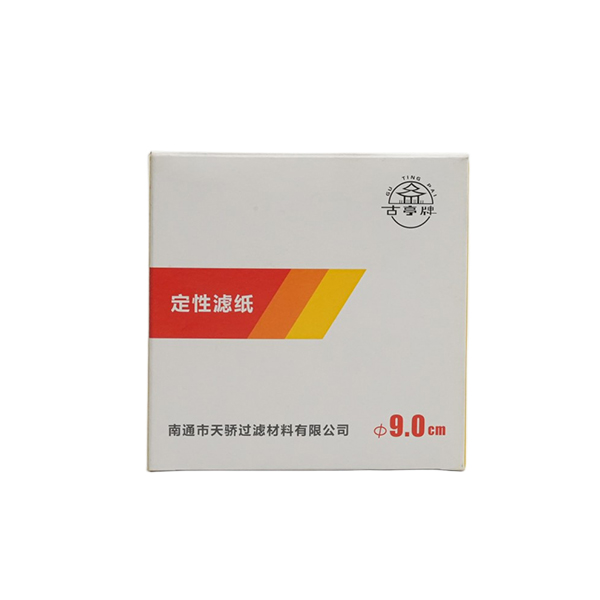
Qualitative analysis filter paper
Core Positioning: Essential laboratory filtration consumables designed specifically for routine qualitative experiments—excluding gravimetric analysis—as well as liquid clarification and solid-liquid
I. Core Materials and Manufacturing Process
This qualitative filter paper utilizes high-purity refined cotton linters and alpha-cellulose fibers as its primary raw materials. Produced through a specialized papermaking process, it features a uniform fiber distribution and a regular pore structure. Free from binders, fillers, and other extraneous impurities, it maximally preserves the inherent filtration properties of cellulose, thereby preventing secondary contamination of experimental samples.
The product features strictly controlled ash content, with a typical ignition residue of less than 0.13%. Classified as a low-ash qualitative filter paper—while not suitable for precise gravimetric analysis—it fully meets the requirements for routine laboratory tasks such as qualitative identification, sample pretreatment, and impurity separation, balancing both filtration efficiency and cost-effectiveness.
II. Key Product Advantages
• Stable Filtration Performance: Characterized by uniform and controllable fiber pores, it achieves effective solid-liquid separation. It efficiently retains suspended particles and precipitates while ensuring the smooth passage of liquids, minimizing issues such as filtrate leakage or clogging. It is suitable for the routine filtration of most aqueous solutions and organic extracts.
• Excellent Wet Strength: The paper is flexible and resilient; it resists tearing, deformation, and fiber shedding when wet. It can be directly folded and shaped for use with funnels and withstands prolonged liquid immersion during filtration. Routine filtration tasks can be completed using a single sheet without the need for stacking multiple layers, ensuring convenient operation.
• Moderate Adsorption: It exhibits low adsorption levels for standard inorganic and organic samples, thereby minimizing sample loss and ensuring the accuracy of qualitative experimental results. Simultaneously, it possesses sufficient adsorption capacity to meet specific requirements for pollutant retention and sample pretreatment.
• High Versatility: Compatible with various standard glass funnels, Büchner funnels, and filtration apparatuses, it requires no specialized equipment. It is suitable for a wide range of applications, including educational instruction, basic scientific research, corporate quality control, and on-site environmental rapid testing, offering low consumable costs and excellent value for money.
• Comprehensive Specifications: Available in a wide range of sizes and flow rates, allowing users to flexibly select the best option based on specific sample characteristics and filtration requirements. Both standard circular formats and pre-folded versions are available to enhance experimental operational efficiency.
III. Product Classification and Technical Specifications
(I) Classification by Filtration Flow Rate (Industry-Standard Designations)
| Flow Rate Type | Identification Color | Pore Size Range | Applications |
| Fast Qualitative Filter Paper | White | 20–25 μm | Large particulate precipitates, viscous liquids, clarification of biological fluids; samples requiring rapid filtration, such as coarse-particle suspensions and organic extracts. |
| Medium-Speed Qualitative Filter Paper | Blue | 8–11 μm | Routine qualitative analysis, general-purpose liquid filtration (e.g., chloride and sulfate detection), routine sample clarification, and basic school laboratory experiments. |
| Slow Qualitative Filter Paper | Red | 2.5–5 μm | Retention of fine particles, fine sample pretreatment, filtration of low-concentration suspensions (e.g., separation of trace impurities and clarification of soil leachates). |
(II) Standard Dimensions and Specifications
Common Circular Sizes: Φ7cm, Φ9cm, Φ11cm, Φ12.5cm, Φ15cm, Φ18cm; compatible with funnels of various specifications. Custom square sizes are available upon request to meet specialized requirements, such as industrial filtration and large-area sampling.
IV. Applicable Scenarios and Fields of Application
1. Educational and Teaching Settings
Used in chemistry, biology, and environmental science laboratory courses at primary schools, secondary schools, and universities. Ideal for teaching basic filtration techniques, conducting qualitative chemical experiments, and performing simple solid-liquid separation tasks. These filters help students master core filtration procedures; their low consumable cost makes them suitable for bulk use.
2. Scientific Research Laboratories
Suitable for basic research sample pretreatment, liquid clarification, impurity removal, and qualitative identification experiments that do not require precise quantification—such as filtering plant extracts, analyzing soil nutrients, and separating impurities from aqueous solutions. When paired with standard funnels, they facilitate rapid filtration.
3. Industrial and Quality Control Settings
Used for routine quality control filtration in the food, chemical, and daily chemical industries; applications include detecting impurities in oils, preliminary water quality filtration, and separating suspended solids from raw materials. In the environmental protection sector, they are utilized for air dust sampling, basic water quality monitoring, and coarse filtration or sample pretreatment within industrial production processes.
4. Other Settings
Applications include routine sample filtration in healthcare institutions, soil and seed analysis in agriculture, rapid sample pretreatment for field testing, and various other filtration tasks requiring simple solid-liquid separation where precise weighing is not required.
V. Precautions for Use
• This product is a qualitative-grade filter paper intended for specific purposes. It should *not* be used for experiments with extremely stringent requirements regarding ash content or purity—such as gravimetric analysis or precise quantitative analysis. For such scenarios, the use of quantitative filter paper is recommended.
• Select a filter paper with an appropriate flow rate based on the particle size and viscosity of the sample: use a fast flow rate for large particles, a slow flow rate for fine particles, and a medium flow rate for standard samples. This ensures efficient filtration and prevents issues such as excessively slow filtration or incomplete filtration (leakage).
• When in use, fold the filter paper according to standard methods to ensure it fits snugly against the inner wall of the funnel, thereby avoiding gaps that could compromise filtration efficiency. When filtering highly corrosive liquids, it is advisable to test for compatibility in advance to prevent damage to the filter paper.
• Store the product in a cool, dry, and well-ventilated environment. Avoid exposure to moisture or direct sunlight, and keep away from corrosive gases to maintain the paper's structural integrity and extend its shelf life.
VI. Selection Recommendations
For general laboratory use and educational experiments, medium-speed qualitative filter paper is the preferred choice, as it is suitable for the vast majority of basic experiments. Fast-speed paper is recommended for filtering large particles or viscous liquids, while slow-speed paper is ideal for filtering fine particles or delicate samples. Filter size should be matched to the diameter of the funnel; for standard experiments, the universal sizes of Φ9 cm and Φ11 cm are prioritized, as they offer superior cost-effectiveness for bulk purchasing.
Product Summary:
As a fundamental laboratory consumable, qualitative filter paper has become the preferred choice for a wide range of routine filtration tasks, thanks to its stable filtration performance, excellent wet strength, affordable cost, and comprehensive range of specifications. Balancing both practicality and versatility, it effectively meets the core requirements of diverse settings—including educational instruction, scientific research, and industrial testing.
Related products
-
$44.00
Aenean bibendum posuere neque, quis hendrerit libero ultrices lacinia. Vestibulum venenatis elit non bibendum pulvinar. In luctus urna sapien, posuere fermentum nunc tempus eget. Fusce hendrerit nec diam quis ornare. Duis auctor, libero in efficitur finibus, purus diam maximus est, et rhoncus sapien justo nec sem
-
$88.00
Curabitur ultricies ante ultricies blandit placerat. Phasellus fermentum, ligula sed vestibulum blandit, mi odio laoreet sem, a venenatis tellus felis eu justo. Nullam ut felis et mauris iaculis malesuada. Donec non turpis vel lectus accumsan rutrum. Vestibulum finibus nunc libero, vel dapibus mauris porta vitae.
-
$7,800.00 – $10,000.00Select options This product has multiple variants. The options may be chosen on the product page

eget ullamcorper leo auctor. Donec at interdum nibh, in blandit massa. Nam pulvinar mollis quam, vel fringilla mi interdum elementum. Donec ullamcorper turpis et libero sagittis vestibulum. Donec enim nisl, rhoncus vitae magna eu, convallis tempus tortor. Integer et facilisis metus.
-
$84.00
Integer feugiat eget quam non egestas. Fusce ullamcorper dapibus eleifend. Nullam ornare pulvinar lacinia. Nunc tempus facilisis ullamcorper. Nam sit amet suscipit risus, ut ultricies felis. Vivamus a finibus nisi. Sed quam sem, accumsan eget tristique sit amet, suscipit sit amet augue. Duis dolor dui, sagittis at faucibus ac, varius et sapien
-
$56.00
Cras mollis dolor sed tempor iaculis. Duis ac ante quam. Donec nec justo erat. Nam a augue vel ex venenatis interdum sit amet ac quam. Interdum et malesuada fames ac ante ipsum primis in faucibus. Vestibulum erat lectus, cursus at dui in, fringilla commodo lectus. Quisque eu bibendum quam, eget euismod sem



Reviews
There are no reviews yet.